
.png)


Blog
Pride Is a Verb
June 5, 2026
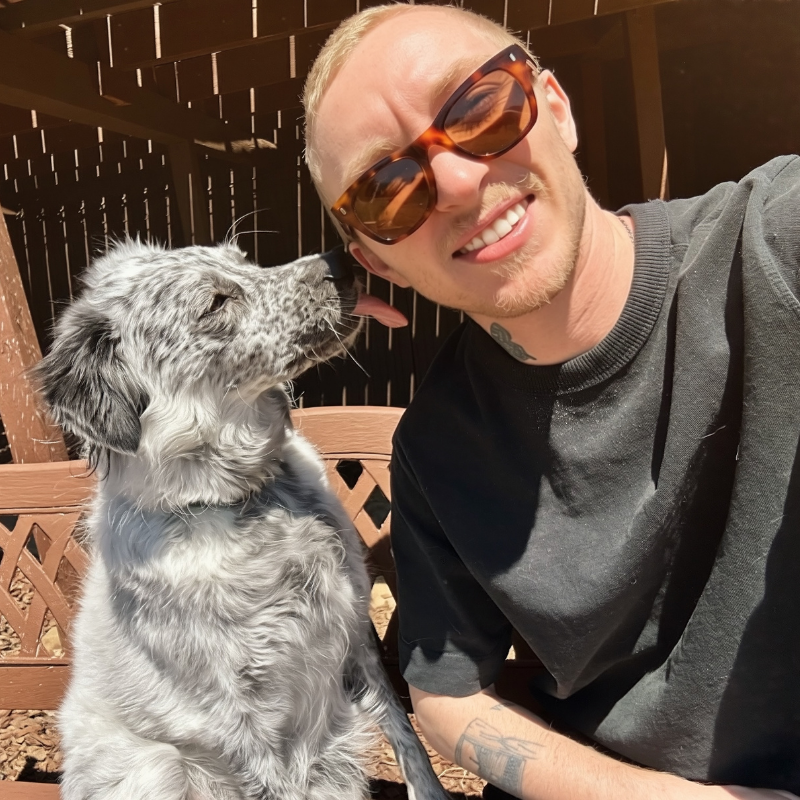
By Finn Cusano, Senior Executive Assistant
Every June, people probably spend some time pondering into oblivion what "Pride" means. The easy answer is that Pride means being proud of who you are. The harder answer, and the one I've spent most of my life learning, is that pride isn't a feeling at all. It's a practice.
It would be nice if pride arrived fully formed, like a package dropped neatly at your doorstep, wrapped with a bow. It would be nice if one day you simply woke up, looked in the mirror, and thought, "There I am. Problem solved!"
I won't speak to others' experiences, but that isn't how it worked for me. It was much like puberty: slow, angsty, all over the place, full of slammed doors and curfews, fueled by childhood wonder and curiosity, and eventually self-defined.
I grew up in a small, politically conservative town where being transgender wasn't something people talked about. I also grew up in a hoarder's home, with family members addicted to World of Warcraft and not much personal access to the Internet. I didn't know what transgender meant until I was 17 (maybe later, but who's counting). Queer people existed somewhere else: on television, in cities, and in conversations happening far away from me. If you had asked me what a lesbian was, I probably would have said, "Ellen DeGeneres," followed immediately by, "I'm not Ellen, so I'm not a lesbian."
For years, I was a poet before I was anything else. Poetry became the place where I could tell the truth before I knew it was any truth, let alone mine. Again and again, I would write myself as a boy, not intentionally or strategically, but instinctively and absentmindedly. The page knew before I ever did.
Sometimes after performances, people would approach me and ask, "Are you trans?"
"No," I'd answer. And I'd laugh.
I was an androgynous, masculine-presenting lesbian at the time, and I had a carefully constructed explanation ready whenever the question came up. To be fair, I had always been good at constructing explanations. When I was 17, after kissing a girl for the first time, I wrote in my journal: "I kissed Scout. She is the exception to my heterosexuality." That journal entry is now literally framed in my house. Scout, for the record, is still one of my best friends.
But, if I could go back in time and be born a boy, would I? Absolutely. But that's a pipe dream, not a realistic, tangible option. Besides, I worried that being transgender would mean spending the rest of my life chasing something impossible. What if I could never be enough? What if I spent my entire life trying to become someone I could never fully be? How could anyone possibly cope with that?
One day, I had a realization so simple it almost felt insulting: we are all doing the best we can with what we have, and often it doesn't feel like enough.
I had spent years extending grace to everyone except myself. The truth was that I wasn't choosing between perfection and imperfection. Nobody gets that choice. I was choosing between living further away from myself or moving as close as I could get (without magic). I would never get to be born a boy, six feet tall, dark, and handsome, but I could become a (somewhat) perceivable man. Not in the way I imagined when I was younger. Not perfectly. Not magically. Not without complications. But honestly. And maybe honesty was enough.
That realization changed everything, not because it solved every problem, but because it gave me permission to stop trying to solve myself.
One of the unexpected gifts of being transgender is that it has made me deeply suspicious of boxes. When your own existence doesn't fit neatly into the categories you were handed, you begin to notice how often society mistakes categories for reality. People are always trying to sort each other into categories: good or bad, liberal or conservative, smart or unintelligent, successful or unsuccessful, masculine or feminine. But human beings are rarely, if ever, that simple.
Being trans taught me that people contain far more possibility than the labels placed upon them. It taught me curiosity, creativity, compassion, resilience, and perhaps most importantly, humility.
For a long time, I was angry at people who didn't understand transgender experiences. I'll admit it: some deserved that frustration. Some didn't.
As I grew older, I realized that misunderstanding is often inherited long before it is chosen. People learn from families, communities, schools, media, religious traditions, and cultural assumptions that existed before they even arrived on this earth. That doesn't mean harmful beliefs should go unchallenged. It means challenge and condemnation are not the same thing. One seeks understanding. The other seeks victory.
I've discovered that very few people have ever changed because they were shamed into it. Most people change because someone created enough space and softness for them to ask a question they were afraid to ask.
Sometimes my role is educator. Sometimes my role is listener. Sometimes my role is simply remembering that another person is also doing the best they can with what they have, and that often it isn't enough.
The older I get, the more I believe that Pride is not about proving that one group of people is right and another is wrong. It is not about separating people into distinct boxes. It's about making room for complexity, room for growth, room for people to become who they are, including ourselves. It is understanding that boxes are useful tools but terrible homes. They protect things during transit, but eventually they're meant to be opened, explored, broken down, and repurposed. That lesson follows me into every part of my life, including work.
Being transgender has shaped the way I show up professionally in ways I never expected. It made me adaptable, resilient, humorous, and comfortable navigating uncertainty. It made me willing to say the thing nobody wants to say aloud. For better or worse, being transgender taught me early that I would often be remembered before I was understood. I couldn't always control what people noticed first, but I could control how I showed up afterward. So I learned to be prepared, to know my material, to work hard, to show up, and to earn trust through consistency. Over time, I realized those habits weren't burdens. They became strengths.
Being trans taught me how to communicate across differences. It taught me how to advocate for myself while also understanding perspectives that differ from my own, and to have compassion for the simple act of being human, for learning and unlearning and relearning, and knowing that process is a cycle that should repeat itself ad nauseam. Most of all, it taught me that every person carries a story you cannot see. One of addiction, recovery, being unhoused, couch surfing, hoarding, shedding, the blossom, the bloom, or the rot. You never fully know. A really great poem once taught me, "you can't stare at a red dot and say the whole painting is just one color."
The colleague who seems distant, the supervisor who appears overly cautious, the employee who struggles to find confidence, and the person sitting quietly in the back of the room are all carrying something, and the revelations of those stories only help us become better listeners and better humans.
When you've spent years trying to understand yourself, you become less interested in judging others and more interested in understanding them. That mindset has made me a better coworker, a better leader in the spaces I lead, a poet who cares less about the outcome and more about the creative journey, and ultimately a better human being. And yes, if we're being honest, it has also given me a sense of humor.
You have to laugh sometimes. You have to laugh when people assume you're ten years younger than you are. You have to laugh when people are confused by the facial hair and the voice. You have to laugh when your driver's license photo feels like forgery. You have to laugh because life is absurd and beautiful and strange. And because laughter is often what allows us to keep moving.
Which brings me back to Pride.
I don't think Pride means believing everything about yourself is perfect. I don't think it means never feeling doubt. I don't think it means having every answer. I think Pride means standing in front of your own reflection and saying:
This is who I am today. This is the life I have. This is the body I have. This is the journey I'm trekking. And I will meet it honestly and eagerly, in whatever shape I'm in. Full heart and all.
For me, that honesty led me to being transgender. It led to hormones and a newfound appreciation for short kings. For someone else, it might lead somewhere entirely different. The destination isn't the point. The courage is. The willingness to move closer to yourself is. The willingness to let others do the same is. And if we're lucky, along the way, we find people who make that journey easier: a handful of really good friends, a chosen family, and, for some, a blood family that gets it. The people who look at us exactly as we are and say, "I'm so glad you've arrived." Treasure those people where you can. Sometimes they've been waiting for us longer than we've been waiting for ourselves. If you've found those people, you've found something extraordinary.
My hope is that each year, each conversation, and each act of understanding makes that circle a little larger. Not just for transgender people. Not just for LGBTQ+ people. For everyone. Because every human being deserves the chance to become more fully themselves. And every human being deserves a world spacious enough to let them try.
That, to me, is Pride.
.png)